How Royal NLR Uses Smart Eye Pro to Reveal Cognitive Skills in ATC Training
Royal Netherlands Aerospace Center (Royal NLR) integrated Smart Eye Pro eye tracking into an air traffic control (ATC) simulator to make trainee cognitive skills visible to instructors in real time and during debrief. Using a multi-camera Smart Eye Pro setup around the radar display, NLR captured robust gaze and pupil data and linked it to simulator events to support performance-based training.
“With Smart Eye Pro, we could make cognitive skills like situational awareness and workload management visible to instructors. The system proved particularly useful for research purposes, capturing eye movement on larger ATC radar screens, and providing valuable additional parameters.”
— Petra ten Hove, Project Lead at Royal NLR
Background
Royal NLR is the Netherlands’ national research institute for aerospace, carrying out applied research in many areas, including aviation safety and efficiency. In air traffic control training, NLR saw a gap: while technical skills can be measured and assessed, non-technical skills like situational awareness, workload management, and decision-making are harder to observe. Eye tracking made these invisible processes measurable, giving instructors a clearer picture of how trainees handle complex situations.
Customer Goals
- Give instructors objective, easy-to-read insight into situational assessment, workload management, and decision-making.
- Provide live support during sessions and structured metrics for debriefs, without disrupting normal training.
Why Eye Tracking
Non-technical skills are hard to observe. Eye tracking shows what trainees monitor, miss, and return to – offering a clear signal of attention, scanning patterns, and moments of strain.
How Smart Eye Pro Was Used:
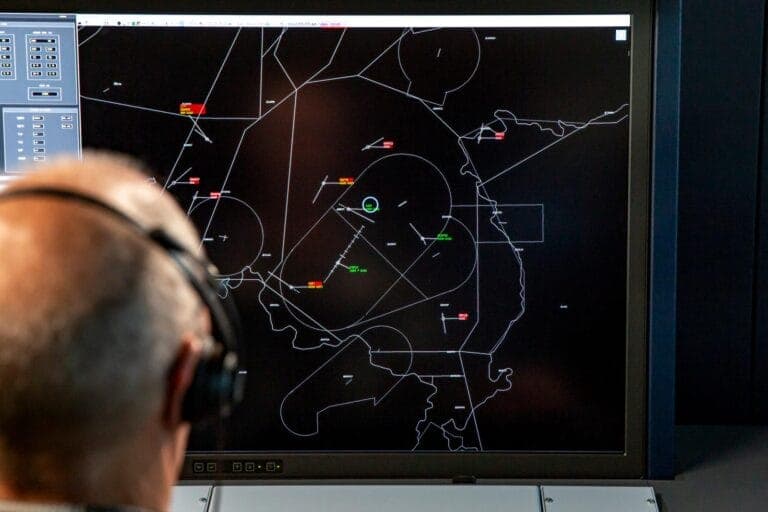
At the core of the project was Smart Eye Pro, configured with four infrared cameras mounted around the radar screen. This setup made it possible to track gaze and pupil size even as trainees moved naturally in their seats. The system’s remote, multi-camera design fit seamlessly into the ATC workstation and worked well with the large 40K radar display used in this phase of training, offering a broader tracking range than standard single-bar eye trackers.
Data into Insight
Smart Eye Pro captured detailed gaze and pupil data, which was synchronized with simulator events such as flight positions, traffic types, and communication logs. From this combined dataset, NLR generated clear measures of key cognitive processes.
These included:
- Perception: How consistently trainees monitored aircraft under control.
- Anticipation: How quickly inbound traffic was noticed once it appeared on screen.
- Workload: Patterns shown through pupil dilation and communication density.
- Scan patterns: Classification into phases of situational awareness, including conflict detection, tunneling, and monitoring.
- Decision-making: When conflicts were predicted versus when action was taken.
Results
Demonstrations showed that Smart Eye Pro data made differences between novice and experienced controllers clear. Novice trainees displayed more variable monitoring and workload patterns, while experienced instructors maintained steadier attention. For the first time, instructors could point to concrete, time-stamped evidence of reduced situational assessment or rising workload, anchoring their feedback in measurable data.
By pairing Smart Eye Pro with simulator data, NLR turned cognitive processes into observable results – giving instructors practical, session-ready insights without complicating the way they teach.