Driver Psychology and Eye Movement in Personalized Driving Systems with Tongji University
This customer testimonial was created in collaboration with Tongji University and Smart Eye.
“By combining research on the lane keeping assist function and Smart Eye’s detection function of the driver’s head and eye gaze, our laboratory has developed a prototype of the lane keeping assist function based on the driver’s state and the prototype of the automatic lane changing function based on the gaze interaction.”
— Prof. Hui Chen, Chassis Electronic Control System Laboratory Lead at the College of Automotive at Tongji University
Background
The College of Automotive at Tongji University was established in 2002 and is located on the Jiading campus of Tongji University. The college has collaborated with many well-known domestic and foreign auto companies, such as SAIC Volkswagen, FAW-Volkswagen, SAIC Motor, UAES, Continental AG, and Geely Auto, to establish school-enterprise joint training models for students, including enterprise practice, university-based engineering teaching, and joint training for automobile reserve engineers. At the same time, it has offered dual-degree master’s programs with well-known foreign universities, such as Darmstadt Technology University and Stuttgart University, to build a comprehensive platform for international exchange and educational cooperation. The laboratory has a fixed-base driving simulator platform based on the mass-produced EPS system, as well as a real-vehicle platform.
The laboratory has been engaged in the research of Lane Centering Control systems and Automated Parking systems for a long time. Recently, the laboratory has been gradually conducting research on personalized systems and driver psychology related to eye movement.
The Solution
Since the research content of the laboratory pays attention to the driver’s condition while driving, Tongji University had known about the head-mounted detection equipment before, such as Tobii and Forum 8.
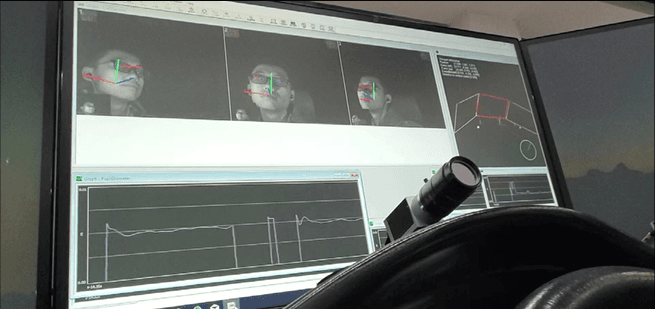
After an introduction by Toyo China, Tongji University became increasingly familiar with Smart Eye’s products, including their non-invasive head and eye movement detection device. Smart Eye has high detection accuracy without requiring contact with the person being tested. It also provides signal output via the CAN bus, enabling communication with other hardware devices such as rapid control prototypes. It greatly facilitates the hardware-in-the-loop simulation experiment for vehicles. It can also obtain driver state information when the driver interacts with the vehicle in a driving simulator.
By combining the previous research on the lane keeping assist function and Smart Eye’s detection function of the driver’s head and eye gaze, the Tongji University laboratory has developed a prototype of the lane keeping assist function based on the driver’s state and a prototype of the automatic lane changing function based on gaze interaction.
The lane-keeping assist function, based on the driver’s state, can better understand the driver’s distraction and provide different levels of assistance in distracted and non-distracted states. The automatic lane changing function based on gaze interaction enables the driver to turn on the automatic lane change function only by gazing at a specific area without manually manipulating the buttons.
The Results
As a non-invasive head and eye movement measurement device, Smart Eye can greatly reduce the discomfort caused by contact with the tested person. At the same time, the quickness of the calibration for the device can effectively reduce the location accuracy requirements for device installation. Also, the 3D model can be customized in the software, enabling quick calculation of the gaze target and the tested person’s viewpoint position.
By combining prior research on the lane-keeping assist function and Smart Eye’s detection of the driver’s head and eye gaze, our laboratory has developed a prototype of the lane-keeping assist function based on the driver’s state and a prototype of the automatic lane-changing function based on gaze interaction. The lane-keeping assist function, based on the driver’s state, can better detect driver distraction and provide different levels of assistance in distracted and non-distracted states. The automatic lane changing function based on gaze interaction enables the driver to turn on the automatic lane change function only by gazing at a specific area without manually manipulating the buttons.
With the research and promotion of Level 3 autonomous driving, driver status monitoring will gradually become a necessary function. Smart Eye’s high-precision and non-intrusive features can make it used as a calibration tool to calibrate and test the corresponding devices.
Moving forward, the 3D model in Smart Eye software can enable fast calculation of the driver’s gaze target, but the established process for building the 3D model often requires professionals to build from scratch, which is troublesome. When implemented in the automotive field, the import of commonly used model formats is extremely convenient for model creation and replacement. In addition, establishing a 3D model requires high positional accuracy of real-world objects, which will greatly affect the accuracy of the viewpoint position. We hope that there will be a more accurate and convenient way to measure the position of the actual objects in the real world.