How KITE Research Institute is Leveraging Eye Tracking to Improve Road Safety Outcomes
This customer testimonial was created in collaboration with KITE Research Institute at UHN and Smart Eye.
“We would happily recommend the Smart Eye Pro system to any researcher who needs robust remote eye tracking, and in fact have demonstrated the system to visitors when asked. We also expect that when the funds allow, we will upgrade to the latest ‘DX’ system, allowing for even better tracking performance, with smaller, less intrusive cameras, and all of the positive features we have become accustomed to.”
— Bruce Haycock, Scientist at KITE Research Institute at UHN
Background
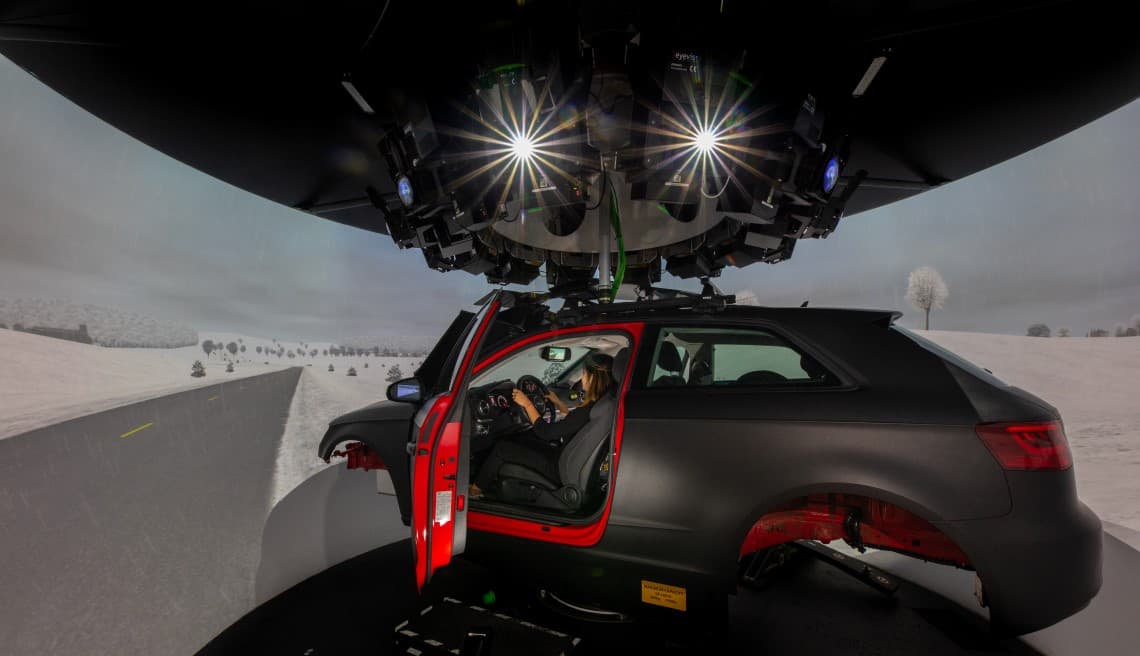
The research arm of the Toronto Rehabilitation Institute, KITE, is one of the principal research enterprises at the University Health Network (UHN). KITE is a world leader in complex rehabilitation science, and is dedicated to improving the lives of people living with the effects of disability, illness and aging. It is home to DriverLab, a state-of-the-art driving simulator featuring a large 7-degree-of-freedom motion system and 360-degree field-of-view visual dome. With vehicles as the leading cause of death in Canada, DriverLab uses simulation to develop tests for fitness and driving safety, provide recommendations, and investigate the effects of health and medications on driving. DriverLab is the only simulator of its kind in Canada and is comparable to the most sophisticated driving simulators worldwide, with rain and glare systems that make it truly unique.
Research Objectives
The DriverLab aimed to develop sensitive methods for driver assessment, more effective methods for driver training, better recommendations for vehicle design, mitigation of drowsy and distracted driving, an evaluation of the effects of prescription and illicit drugs on driving, and a careful evaluation of the interactions between drivers and integrated vehicle technologies. To achieve its objectives, the DriverLab vehicle retains its original internal components (e.g., steering wheel, gas/brake pedals, seats, dashboard) and also requires customizable interfaces and sophisticated measurement tools, including a state-of-the-art eye-tracking system.
The Solution
In order to meet each of its objectives, researchers evaluate driving performance across a wide range of populations (individuals of different ages, with sensory, cognitive, or physical impairment) and across a wide range of driving scenarios. Scientists work closely with collaborative partners including the Ontario Ministry of Transportation, driver examiners, clinicians (including geriatricians and family physicians), automobile manufacturers, and simulation development companies. Specific research objectives include assessing the effects of medications on driving performance and investigating the role of cognitive and physical training programs on safe driving outcomes.
Selecting Smart Eye Pro for integration into DriverLab was an easy choice, as it was the only remote tracking solution on the market that consistently delivered robust tracking performance. When KITE began to use the system, they were able to get it up and running quickly, and the tracking performed well, meeting all expectations.
The Results
Smart Eye provided excellent technical and product support. While the initial performance was “as expected” based on demonstrations, subsequent software updates to Smart Eye Pro provided useful performance improvements and additional features.
The latest example was the ability to track a masked face in Smart Eye Pro 9.1, which was not even remotely considered at the time of purchase but became a very welcome addition to solve an unforeseen niche problem. Early in the COVID-19 pandemic, all in-person research was paused as the lab is located in a hospital. When in-person research resumed, precautionary measures were required, including distancing and the use of medical masks.
However, as a motion simulator, we require a researcher in the vehicle for safety and do not have the option to open vehicle windows for airflow as a real vehicle would. Until the release of 9.1, this left us with the choice between no eye tracking or an unmasked participant in an enclosed space with the researcher for the duration of the experiment. As a result, we were able to continue our research as planned.