This customer testimonial was created in collaboration with Hinfact and Smart Eye.
“There are several reasons why we chose the Smart Eye Pro as an eye tracking solution. For one, the system is the only one offering multi-camera solutions with high precision”
— Thomas Bessiere, Co-Founder and CEO at Hinfact
Background
Hinfact’s research focuses on the very foundation of flight safety: the training of pilots.
Hinfact creates and develops technologies supporting commercial aircraft’s pilot training and training centers. Flight data, gaze direction analysis, and Hinfact’s own analytics are used in the evaluation of human factors in flight situations. Data analysis combined with technology like eye tracking is what allows Hinfact to detect critical flight situations and conduct research to improve flight safety. Thomas Bessiere, co-founder and CEO of Hinfact, describes a problem they encountered through their research:
“In critical and perhaps stressed situations, pilots do not always realize that they are losing vital scan behaviors leading up to critical simulation parameters being missed. Our laboratory started working on ways to identify when and how this occurs.”
By identifying key performance indicators, Hinfact can help instructors detect a pilot’s strengths and weaknesses – and improve their assessment of pilot performance in real time. Hinfact relies on a thorough scientific background, which allows them to learn and benefit from large resources of experience and research.
“As a spin-off of the Human Factors Lab at ISAE-SUPAERO, we have direct access to 17 years of research in this field. We work every day with the scientists who are globally known as references in Human Factors in the aviation field,” says Thomas Bessiere.
How Eye Tracking Adds Value to Pilot Training
The idea for a tool that would vastly improve pilot training was born when studying the flight simulators used in training centers.
“We started discussing with the instructors in the training centers, and we observed that the instructor is behind the pilots in the simulator, and that they have no way of knowing where the pilots are looking and focusing their attention,” says Thomas Bessiere.
Hinfact realized that eye tracking technology is the application best suited to provide the missing feedback on pilots’ behaviors. On average, pilots spend 90% of their time monitoring flight parameters and the state of the aircraft. Therefore, it was crucial to find an eye tracking system that provided the technology necessary to track eye movements with the highest possible precision.
With a tool that tracks the pilot’s gaze, the instructor can follow the pilot’s attentional focus and optimize monitoring behavior in critical training situations. This is something that would add value and efficiency to the training process and result in better prepared pilots.
Not only will pilot training benefit from technology that lets instructors track the pilot’s gaze in real time, but the data can also be saved and analyzed after the simulation session. Together with the instructor, the pilot can increase their awareness of monitoring behaviors they might never have noticed on their own.
Higher efficiency combined with higher accuracy can be expected to reach even higher importance in the years to come. Global demand for commercial airline pilots is likely to be twice as high in just 20 years, requiring training centers to prepare for an upcoming mass recruitment of pilots. In this scenario, eye tracking will become essential for successful recruitment and training of pilots.
“This is the reason why eye-tracking will become necessary in pilot training sessions. However, it is quite difficult for instructors to understand eye-tracking data without a Human Factors background to help them with the interpretation. This is why we created Gazecraft Training – to support instructors in the assessment of pilots’ skills and monitoring performance,” says Thomas Bessiere.
The Gazecraft Analytics Tool and Smart Eye Pro
Extensive research on pilot training led Hinfact to start working on The Gazecraft Analytics tool, which is currently in development and will be available around mid-2020.
“We rely on our researchers’ studies to provide several metrics and visualization methods in our Analytics tool. Specific algorithms and data aggregation methods are used to display comprehensive visual patterns and to differentiate the beginners’ and experts’ scan patterns,” says Thomas Bessiere.
Thomas Bessiere also describes how Hinfact has collaborated with UX and UI designers to make the advanced tool easy for instructors to use. “They just need to look at the tablet, and they have the gaze position of the pilots displayed on the screen. After the training session, they have a direct link to all important flight events and can analyze them on the tablet, either in a static or dynamic view. Our main strength is that we provide eye-tracking to the instructor with a high level of post-processing to give them intelligible information on monitoring performance.”
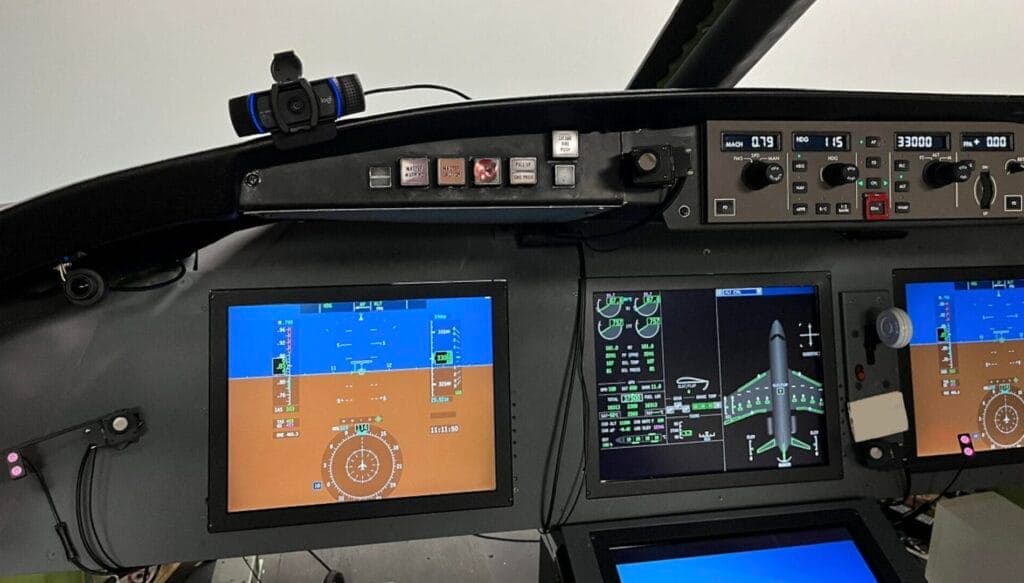
Additionally, the tool is designed for integration into different simulator platforms: “Our goal is to provide a tool that is standardized for the whole training center. Then, because most airlines and training centers have different types of sims, it is important to stay on top of the simulators as an add-on. We provide a full suite that has been designed to remain adaptable and generic. As of today, we can use and deploy the Gazecraft suite in all training centers where instructors need to be able to assess monitoring skills,” says Thomas Bessiere.
The Final Product
After years spent developing and perfecting the Gazecraft Analytics tool, the final product includes a combination of Smart Eye’s head and eye tracker technology and Hinfact’s gaze data analysis – all easily used and operated by the flight instructor alone. And according to Thomas Bessiere, it will not take too long before the tool is available on the market.
“We already have a final product; the tool is ready to be used in simulators that are limited in terms of accessible data. The only thing that is missing is the integration into a full-flight simulator and creating all events and procedures linked to specific scenarios with our clients. We are targeting early 2020 for a full implementation available on full-flight simulators with initial packages of rules and procedures,” says Thomas Bessiere.